Sunday, July 13, 2014

Army Football Team Guidon

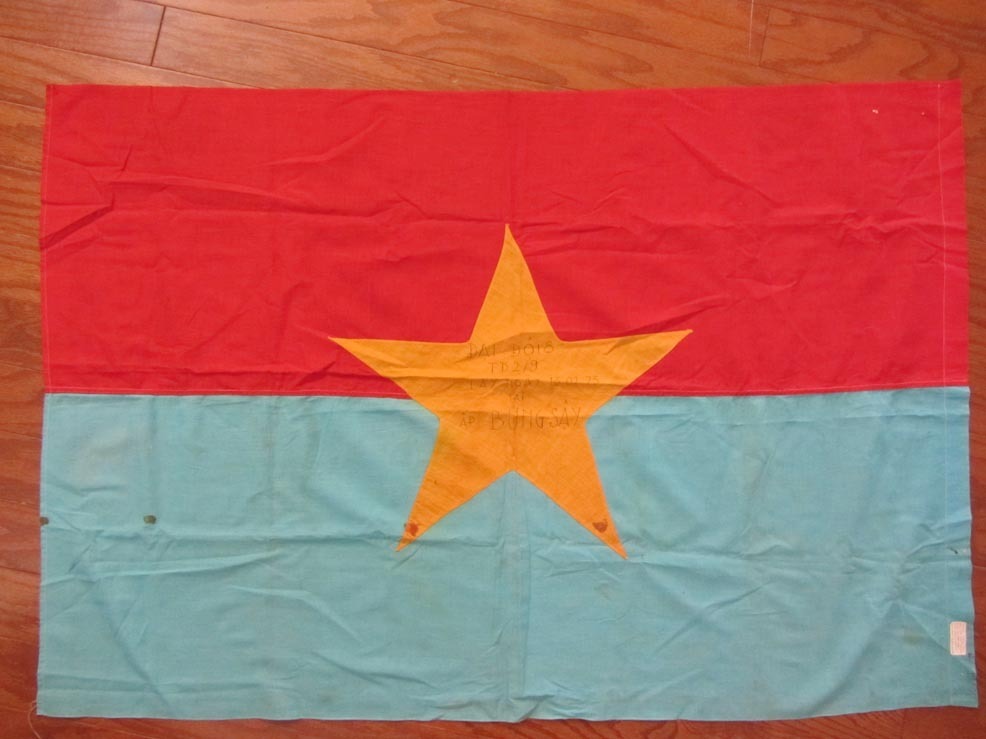
                      One of the recent additions to our website was this guidon commemorating a football game played by a team from the Army of the Republic of Vietnam's 2nd Supply and Security Battalion. The unit served in the 2nd Military Region, and the game was played on April 25, 1971.


        Football was (and is) a popular sport in Vietnam. The Republic of Vietnam was one of first Southeast Asian nations to join FIFA, and was a founding member of the Southeast Asian Peninsular Games (SEAP), today known as the Southeast Asian Games (SEA). Republic of Vietnam military units often organized football teams from among their personnel to play against other military units or civilian clubs. Such activities helped to maintain morale and boost comradery. Guidons were commonly created to commemorate games, and would often hold pride and place in unit mess halls and headquarters.

 
Members of the Republic of Vietnam team at the Southeast Asian Peninsular Games (SEAP) in 1959 with game commemoration guidon.

Thursday, July 3, 2014

RVNHS VIRTUAL MUSEUM UPDATE

After a bit of a hiatus, the RVNHS Virtual Museum has been updated. New pieces have been added to different sections. Please browse the site to view recent additions:


Wednesday, November 6, 2013

New Server Host

As some of you may have noticed the RVNHS website was down for roughly a week recently. This was the result of our transfer of the site to a new hosting service. We sincerely apologize for any inconvenience. The website is now fully back up and running, as is our email account at:   info@rvnhs.com
 
Thank you for your understanding, and we apologize for this minor "glitch."

Monday, October 14, 2013

ARVN 9th Infantry Regiment Captured Viet Cong Flag

ARVN Airborne Officers with Captured Communist Flags
 
As a general practice, RVNHS only acquires material relating to the Republic of Vietnam and its armed forces. However, a slight exception we made some months ago was this period flag of the National Liberation Front, AKA "Viet Cong / VC." The reason for this exception was the unique feature that this flag was captured and kept as a souvenir by the 8th Company of the 2nd Battalion of the 9th Regiment of the 5th Infantry Division of the Army of the Republic of Vietnam.
The flag is marked in Vietnamese as having been captured by members of this unit on Highway 13, near Chan Thanh, on February 15th, 1973.
 
The 9th ARVN Infantry Regiment Captured Flag
 
The flag is signed by officers of the 8th Company, and it was later given to the unit's American advisor who brought it back to the United States. And, this is how it has been kept in the years since, before coming into our possession recently. Captured enemy flags are among the possessions veterans tend to keep, but although such flags captured by American forces are common, it is rare to encounter a piece with strong provenance marked to an ARVN / QLVNCH unit as most of these stayed in Vietnam and were lost or destroyed in 1975.


Insignia Variations for the 9th ARVN Infantry Regiment
 

Wednesday, September 4, 2013

Officer Insignia Misidentifications

RVNHS recently acquired a small grouping of original Republic of Vietnam army and air force rank insignia. The grouping was compiled over many years by a private collector. Among the grouping, labeled by the collector as an "ARVN 2nd Lieutenant" rank, was this insignia:

ROC Army Major Rank

This was not the first time we have seen this insignia labeled as Vietnamese, so we decided to make a post to clarify the matter.
The insignia above is a Republic of China / ROC ("Taiwanese") army insignia. The ROC uses five pointed insignia in a similar style as the Republic of Vietnam did. However, unlike the Republic of Vietnam, the ROC only uses these insignia for senior officer ranks from major (1 blossom) to full colonel (three blossoms). ROC army major to colonel's insignia is gold, while ROC air force major to colonel's insignia is all silver.
This differs from the Republic of Vietnam where 2nd Lieutenant to Captain was denoted with gold blossoms, and major to colonel with silver blossoms. 
The basic difference between the blossoms of the ROC and those of the Republic of Vietnam is that ROC blossoms are one layer with rays of varied length shooting out from the center, while all Republic of Vietnam blossoms were double layer, and  with rays of roughly equal length.
 
ARVN Army 2nd Lieutenant Rank
 

Saturday, February 16, 2013

Little Saigon Tet Festival - Garden Grove 2013


RVNHS was invited to participate with a display in this year's Tet Festival in Garden Grove, California. The festival drew thousands of visitors, many of whom stopped by to view the display. Of particular importance was the opportunity to interact with Republic of Vietnam military veterans who were in attendance. There was a lot of interest in the display. Many conversations took place discussing the history of the Republic of Vietnam, and personal memories of military service. As always, the main purpose of RVNHS for doing these displays is to promote the history of the republic, and interact with veterans and their families. This display was no exception. The Tet Festival proved to be a highly successful event, and we would like to thank all who stopped by to view the display. The many positive comments the display received were greatly appreciated and encouraging. Below are just a few photos of the event.


Tuesday, August 28, 2012

Early Republic of Vietnam VNAF Rank Insignia


In the mid 1960s, many regulations in the Republic of Vietnam Armed Forces were altered. These changes followed the end of Ngo Dinh Diem's presidency. For this reason, today, the earlier and later regulations are sometimes referred to as "Diem Era" and "Post Diem Era." One of the regulations changed was the identification of rank. The rank display change became fully official in 1967, with the publication of the army quartermaster manual for that year. However, photographs from the period show the "newer" rank versions were already in use to some degree before that time.

   Gold and silver colored blossoms began to be used to denote officer ranks from second lieutenant to colonel in the early years of the republic. Gold signified junior officers (second lieutenant to captain), while silver identified senior officers (major to colonel). Aside from color, the gold blossoms were usually smaller in size than silver ones. But, the basic shape and design of the blossoms were the same. In practical terms, this sometimes caused confusion. It could, at times, (for example) be hard to tell if an officer was a second lieutenant (one gold colored blossom) or a major (one silver colored blossom). A faded silver colored blossom could often look identifical to a faded gold colored one (not to mention the difficulty of determining rank through black-and-white photographs, where the color differentiations could not be seen). Thus, a major change undertaken (in the new regulations) to clarify rank identification was to add a bar at the base of major to colonel ranks. This change occured in both the Vietnamese Air Force (VNAF) and Army of the Republic of Vietnam (ARVN).

               Most of the insignia featured in this post was recently acquired by RVNHS. All of these insignia date to the Diem Era, and are for the Vietnamese Air Force. The ranks range from airman (private first class) to colonel. The shoulder boards were attached to loops on the epaulettes of shirts and jackets, and worn as matching pairs. The rounded pentagon-shaped insignia was worn as a single piece, either on the left sleeve or the chest. All of these insignia could be worn both during field / combat duty, as well as on parade.


(Photo: Nguyen Xuan Vinh as a colonel with three silver blossoms, early 1960s).


VNAF Enlisted Ranks (Worn on Left Sleeve or Chest): Senior Corporal, Corporal, Airman.


1962 Dated Photograph of a Senior Corporal, Insignia on Left Sleeve.


Shoulder Boards for Sergeant (Left) and Master Sergeant (Right)


VNAF Sergeant and His Wife, Photograph Dated 1963.


        Shoulder Boards for Warrant Officer (Right) and Senior Warrant Officer (Left)

                                                      
                                                            Shoulder Board for Aspirant

 
Shoulder Boards for Junior Officer Ranks: Second Lieutenant (1 Blossom), First Lieutenant (2 Blossoms), and Captain (3 Blossoms).
 

Shoulder Boards for Senior Officer Ranks: Major (1 Blossom), Lieutenant Colonel (2 Blossoms), Colonel (3 Blossoms).