Friday, October 16, 2015

45th Anniversary: Operation Total Victory 8B5 - Toàn Thắng 8/B/5 - 1970


Soldiers of the 5th Infantry Division riding atop armored personnel carriers.
 
            Forty-five years ago this week, plans were being made for an operation into the Snoul region of Cambodia by the Republic of Vietnam military. Snuol sits near the border with Vietnam, and the corridor running through Snuol and down towards AnLoc in Vietnam was a constant area for enemy activity in the late 1960s-70s. The aim of Operation Total Victory 8B5 was to disrupt and destroy as much as possible enemy activity in the area while gathering intelligence.
 
Map of the Cambodia and Southern Vietnam border with Snuol highlighted.
 
Republic of Vietnam General Nguyễn Văn Hiếu.
 
        The 5th Infantry Division would be the main force in the campaign along with the 1st Armored Cavalry Regiment and the 3rd Ranger Group supported by the Vietnamese Air Force.  Planning for the operation began on October 14th, 1970,  and was principally lead by General Nguyễn Văn Hiếu. The plans were approved by 3rd Corps on October 21st, and following a final meeting on the 22nd, the operation commenced on October 23rd.
 
Insignia of the 5th Infantry Division and principal units, RVNHS Archive.
 
 
         The operation would last for nineteen days, ending on November 10th. The action was planned as a brief strike into Cambodia with Republic of Vietnam forces withdrawing back into Vietnam at its completion. It was one of many such operations the Republic of Vietnam would undertake into Cambodia during the period, and it was neither the first nor the last for the 5th Infantry Division.
 
Officers of the 5th Infantry Division around the time of the Operation Total Victory 8B5, 1970, RVNHS Archive.

Saturday, October 10, 2015

Rural Development Cadre - RDC


Members of the Rural Development Cadre, near Qui Nhon,1969.

            The Rural Development Cadre (RDC) was formed in 1965 as a civilian auxiliary for the Republic of Vietnam. Over time, the scope of the activities of the RDC came to include tasks ranging from civic development projects (such as irrigation canal and housing construction) to conducting public education campaigns (including health awareness and political instruction) to auxiliary security operations in support of the Popular and Regional Forces as well as regular military.
Rural Development Cadre patch, printed, RVNHS Archive.
 
Rural Development Cadre uniform, complete with scarf and insignia, RVNHS Archive.

                            The personnel of the RDC were mainly young men and women who worked for the RDC in rural areas. Some were from these areas, others were from larger cities and towns. At times, the RDC was also known as the "Revolutionary Development Cadre" - as opposed to "Rural" - as the actions and ideology of the RDC were often aimed at progressive development and education in the countryside.
English and Vietnamese language book on the "Revolutionary" Development Cadre,
written by Nguyen Be, 1969, RVNHS Archive.
 
             Most functions of the RDC were civic in nature. Young members of the group assisted in providing health services to poor rural families, the improvement of village life through the construction of communal facilities, and literacy as well as vocational training. Many members of the RDC were educated, and often served with the RDC prior to entering the military, civilian professions, or continuing higher education. From 1965 onward, tens of thousands of young Vietnamese would serve in the RDC. However, in time the effectiveness of the RDC as a counter to enemy activities in the countryside was appreciated by the Republic of Vietnam government, and the RDC came to take on a more prominent security role. This included the collection of intelligence, psychological operations, and also weapons training and providing service as military auxiliaries when needed.

Members of the Rural Development Cadre armed as military auxiliaries
alongside soldiers, 1960s.

Thursday, October 1, 2015

VNAF 83rd Special Operations Group KQVNCH


A Douglas A-1 Skyraider of the 83rd Special Operations Group, mid-1960s.

              The 83rd Special Operations Group of the VNAF (sometimes referred to as the 83rd Special Air Group) was formed in the mid-1960s to act as an elite air combat unit. The unit most famously flew Douglas A-1 Skyraiders. The pilots of the 83rd were highly skilled, and came to have a reputation as an effective fighting force. The unit was closely linked with Nguyễn Cao Kỳ with many pilots being personally selected for the unit by him.

Pilots of the 83rd Special Operations Group
with Nguyễn Cao Kỳ (second from left, bottom row), mid-1960s.
 
83rd Special Operations Group squadron patches.
Right: hand embroidered, Left: printed, RVNHS Archive.
 
              The 83rd was also associated with the 518th Fighter Squadron with many pilots officially serving in both units. The 83rd achieved a number of battlefield successes during its history, but as the war progressed and the VNAF was restructured with different individuals assuming command, the pilots of the 83rd were eventually transferred to other units.

Pilots of the 83rd Special Operations Group with 518th Flight Squadron insignia
 on flight suits and planes, names annotated on photo, 1965.

            Pilots of the 83rd were well known for wearing black flight suits. Former member Hoi Ba Tran, states the change to black flight suits was done in 1965 at the bequest of the unit's new commander Lưu Kim Cương. Black flight suits were also worn by individual VNAF personnel in other units throughout the war, and period photographs also show some members of the 83rd in standard olive-drab suits after the 1965 change.

Lưu Kim Cương during his time with the 83rd Special Operations Group.
He was later killed in action in 1968.
 

83rd Special Operations Group pilots at Tan Son Nhut Air Base, 1965.
Back row, left to right: Ly Ngoc An, Nguyen Huu Bach, Nguyen Huy Cuong,
and Nguyen Quoc Phien. Front row, left to right: Nguyen Cao Ky and Hoi Ba Tran.
 
Hoi Ba Tran in 2012 at the VNAF MAC exhibition in Little Saigon, Orange County.
 
Members of the 83rd Special Operations Group in olive-drab flight suits with US Advisor, 1965, RVNHS Archive.
 

Thursday, September 24, 2015

42nd Anniversary of the ARVN Victory in the Seven Mountains 1973


An ARVN (QLVNCH) outpost near the Seven Mountains, pre-1973 photo.

            Forty-two years ago this month, from July to October 1973, the 44th Special Task Force, mainly comprising the 7th Ranger Group and 4th Armored Group of the Republic of Vietnam, launched an offensive to drive out the 1st North Vietnamese Division from the Seven Mountains region ( Bảy Núi ). The Seven Mountains area is a region in An Giang Province, along the border with Cambodia. Prior to the Republic of Vietnam offensive, the area had become a growing base of operations for Communist infiltration into the republic.

A modern view of Thiên Cẩm Sơn ("Heaven's Forbidden Mountain")
the tallest of the Seven Mountains.
 
Map showing the location of the Seven Mountains.
 
            The terrain of the Seven Mountains consists of rocky slopes covered with vegetation and plains that are often prone to flooding, making the area ideal for defensive positions. Nevertheless, gradually over the summer weeks of 1973 the Republic of Vietnam forces pushed forward. By October 1973, the North Vietnamese 1st Division was virtually destroyed with many of its units down to only fractions of their former strength. Aside from battlefield casualties, the offensive cut supply lines to the Communist forces, resulting in an upsurge of disease and malnutrition among the Communist ranks. By contrast, the Republic of Vietnam casualties were significantly less.
 
A road leading up Thiên Cẩm Sơn, one of the Seven Mountains.
 
            When the Republic of Vietnam rangers supported by armor units finally cleared the Seven Mountains of Communist forces, the republic achieved a great victory, and the area became free from major Communist attacks until the end of the republic in 1975. In the aftermath of the battle, the 1st North Vietnamese division retreated into Cambodia, and due to its immense losses the unit was disbanded. The Republic of Vietnam had carried the day.
 
Republic of Vietnam rangers riding atop an armored unit.


Thursday, September 17, 2015

VNAF Cessna O-1 Bird Dogs in flight Photo


VNAF Cessna O-1 Bird Dogs off the coast of Vietnam, 1960-70s, RVNHS Archive.
 
              From the RVNHS Archive, an original period photo of Vietnamese Air Force (VNAF) Cessna O-1 Bird Dogs in formation flying off the coast of Vietnam. The photograph appears to have been taken from an accompanying aircraft. These planes were commonly used for aerial reconnaissance, target spotting, and other reconnoitering operations. They could be operated by a one or two person crew, and became a mainstay of the VNAF. Please see our August 20th post on Major Lý Bửng's Flight to Freedom for one of the most famous tales of a VNAF Cessna O-1 Bird Dog.

Sunday, September 13, 2015

Republic of Vietnam Regional Forces - Địa phương quân VNCH


Regional Forces unit during training, 1972, RVNHS Archive.
 
             The Republic of Vietnam Regional Forces were initially formed as auxiliaries for the regular army. They were charged with guarding outposts, roadways, and other vital areas. They were organized by battalions, and covered every district of the Republic of Vietnam. By the late 1960s, the regional forces had grown substantially with new battalions continually being raised through 1975.
 
Flag of the Regional Forces and Popular Forces.
 
                Regional forces personnel were often the first to face enemy attacks. As the numbers of regional forces grew, the battalions began to be used in offensive operations as well. The role of the regional forces became an essential part of the defense strategy of the Republic of Vietnam, and during its history hundreds of thousands of would serve as members of regional forces units.
 
Examples of Regional Forces insignia.
Top: Regional Forces sleeve patch, left - printed, right - silk woven.
Middle: Regional Forces Battalion Patches,
left to right - 102nd, 131st, 213th, and 448th Battalions.
Bottom: left to right - 504th and 513th Battalions,
747th Reconnaissance and 838th Reconnaissance, RVNHS Archive.
 
                   Regional forces personnel wore regular army uniforms and equipment. Insignia consisted of a beret badge (usually worn on a black beret) and sleeve patch, which could be colored or subdued. Each regional forces battalion and reconnaissance units also had unit-specific insignia, which was worn on the chest pockets. A handful of units had specific insignia for each company. Some units also had numbered tapes, which were worn above the pockets, or scrolls that were worn on the shoulders. Ranks followed the standard Republic of Vietnam Army system.
 
Regional Forces member with patch on left sleeve, 1969, RVNHS Archive.


Wednesday, September 9, 2015

TQLC Vietnamese Marine General Bùi Thế Lân signed Holidays Card 1969


Bùi Thế Lân as a brigadier general, 1970s.
 
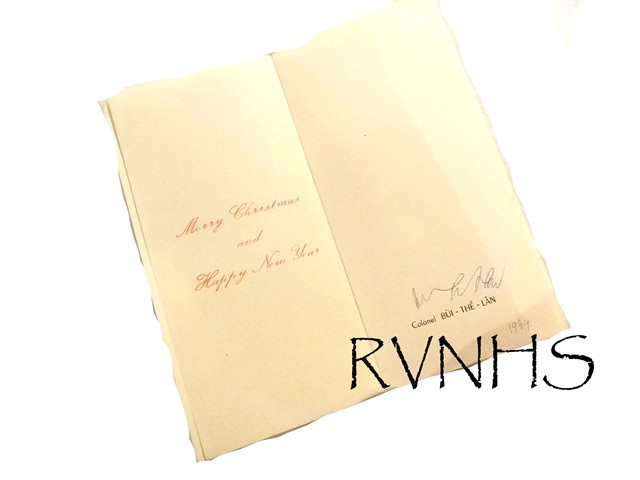
           From the RVNHS Archive, this 1969 personalized Christmas and New Year's card was given by then Colonel Bùi Thế Lân of the Vietnamese marines (TQLC). The card is in English, and was given to American advisors of which Bùi Thế Lân was acquainted. The card bears his embossed name with written signature.
1969 holidays card from then Colonel Bùi Thế Lân, RVNHS Archive.
 
1969 holidays card from then Colonel Bùi Thế Lân, interior view with signature,
RVNHS Archive.
 
          Bùi Thế Lân (1932-2014) would reach the rank of major general, and become one of the most well known members of the Vietnamese marines. He served as commander of the marine division, and was active in veterans' and memorial events in later years. He passed away in January, 2014, at the age of 82 in San Jose, California. In this posting we would like to share this holidays card from this famed Vietnamese marine, and commemorate his legacy.
 
Bùi Thế Lân with President Nguyễn Văn Thiệu, 1970s.
 
Bùi Thế Lân in later years.